
Vintage Longines Ultra-Chron: The best value High-Beat Automatic Vintage Watch every made!
The Longines Ultra-Chron: One of the earliest High-Beat Automatic Innovation – History, Why It’s Special, Key References & 2026 Vintage Outlook
If you’re searching for a vintage watch that delivers genuine horological pedigree without the sky-high prices of its more famous contemporaries, the Longines Ultra-Chron is one of the most rewarding discoveries you’ll make. Launched in 1967 as Longines’ first automatic high-beat wristwatch, it runs at a remarkable 36,000 vibrations per hour (5 Hz) — twice the speed of ordinary mechanical watches — and was marketed with a bold accuracy guarantee of just ±1 minute per month.
Yet despite its technical brilliance and pioneering status, the Ultra-Chron remains remarkably underrated. In this focused study we explore its fascinating history, the groundbreaking movement that made it exceptional, the most important vintage references (with extra emphasis on the iconic Jumbo models and their distinctive case shapes), current market realities, investment potential, and how recent reissues have reignited interest in the originals.
The History Behind the Longines Ultra-Chron
Longines had been obsessed with high-frequency precision long before 1967. The brand filed patents for 5 Hz stopwatches as early as 1910 and produced record-setting observatory chronometers in the late 1950s. The Ultra-Chron line was unveiled in 1967 to celebrate the company’s centenary, landing squarely in the middle of the late-1960s “high-beat wars” when Swiss manufacturers raced to create smoother, more accurate mechanical watches.
Production continued through the early-to-mid 1970s before the quartz crisis brought the high-beat era to a close. What makes the Ultra-Chron stand out is that it wasn’t just flashy marketing — it was a practical, reliable daily wearer that solved many of the real engineering challenges high-frequency movements faced at the time.

(Above: Caliber 431 from a classic vintage Longines Ultra-Chron — the movement that defined the entire line.)
Why the Ultra-Chron Is Truly Special: The Revolutionary Caliber 431
At the heart of the early Ultra-Chron models sits the Caliber 431 (part of the 43x family), an automatic high-beat masterpiece:
- 36,000 vph (5 Hz) — delivering that signature ultra-smooth, almost gliding seconds hand.
- Accuracy guarantee of ±1 minute per month, far exceeding typical 1960s standards.
- Innovative dry lubrication using molybdenum disulfide (MoS₂) — a brilliant fix that prevented oil from being flung off the fast-moving parts, a common failure point in other high-beat designs.
- Glucydur balance wheel, KIF-Ultraflex shock protection, flat Nivarox hairspring, and a 21-jewel construction with bi-directional tungsten-weighted rotor featuring the iconic flying hourglass symbol.
Later examples used related calibers (430/432/433), and some post-1972 models carried the Ultra-Chron name with slightly different movements, but the original Cal. 431 remains the one collectors prize most. It proved high-beat watches could be both precise and robust enough for everyday use.
The Most Important Vintage References
1. The Iconic “Jumbo” Dress Models (Refs. 7950 / 7951 / 7952 and 8300 / 8301 / 8302 / 8348 series)
These are by far the most desirable and collectible vintage Ultra-Chron watches — and the ones we recommend most to new collectors. The “Jumbo” nickname comes from their 37mm case diameter, which was generously large and commanding in the late 1960s and early 1970s when the average dress watch sat around 34–35mm. Today that size feels perfectly modern and versatile.
Case Shape & Style – What Makes the Jumbo Special The defining visual element is the distinctive convex triangular / faceted lugs. These are thick, sharply angled, and geometrically sculpted, giving the watch a bold, architectural silhouette from every angle. The lugs flare outward elegantly yet taper quickly, resulting in a surprisingly compact lug-to-lug measurement that sits comfortably on most wrists. The overall case is rounded with a polished bezel, domed crystal, and a slim profile of approximately 10–11mm thick — elegant enough for a suit yet substantial enough to feel like a serious tool watch on the wrist.
Two generations exist:
- Early series (7950, 7951, 7952): Traditional screw-down case backs opened with a standard pin tool.
- Later series (8300, 8301, 8302, 8348): Often feature a more modern 12-sided case back that requires a special wrench.
Materials add further variety: stainless steel (most common and accessible — 7951 / 8301), solid 18k yellow gold (7950 / 8300), and gold-capped/rolled gold versions (7952 / 8302). The steel models offer the best everyday value and wearability, while gold examples develop beautiful warm patina over time.
Dial Variations Every Jumbo shares the signature crosshair dial (two fine lines crossing at the center) with chunky applied rectangular or block-style hour markers and prominent “Ultra-Chron” script at 6 o’clock. The date window at 3 o’clock usually has a trapezoidal frame. Most sought-after finishes include:
(Above: Longines Ultra-Chron 7952. Photo credit to sabiwatches)
- Classic silver sunburst with crisp crosshair
- Highly coveted dark brown “confetti” textured dials
- Grey sunburst and cream/patina variants
Some have an outer minute track, others are clean and minimalist. The high-beat Cal. 431 movement makes the seconds hand glide so smoothly that you’ll find yourself staring at the dial constantly.
These Jumbos are the perfect everyday vintage Ultra-Chron — refined 1960s elegance paired with serious mechanical innovation.

(Above: Steel Jumbo Ref. 8301-style example — silver sunburst crosshair dial and the unmistakable triangular lugs that define the model’s bold yet wearable character.)

(Above: Close-up of a gold Jumbo dial and hands — showcasing the chunky applied markers, crosshair layout, and refined finishing typical across the reference family.)

2. The Ultra-Chron Diver (Ref. 7970 and variants, introduced 1968)
One of the very first automatic high-beat dive watches ever produced. Cushion-shaped case (approximately 41mm), uni-directional Bakelite bezel (often with striking orange and black insert), and serious 200m water resistance. The bold red/orange minute hand and high-beat sweep make it a standout piece for collectors who love tool-watch heritage.

(Above: The original Ref. 7970 is a rare high beat dive watch from that era. And it is rare for watch manufacturer to put a high beat movement into a tool watch)

(Above: a modern take on the Original Ref. 7970, but the vintage originals have that unmistakable 1960s character and patina potential. I appreciate how much Longines have follow the original design! Photo credit to monochrom watches)
Other notable references include monobloc cases and later COSC-certified chronometer versions and also the non jumbo dress watch model, but the Jumbos and the early diver remain the core of any serious collection.

(Above: The non jumbo Longines Ultra Chron 8071 in 35mm. We love the case shape of these models somewhat reminds me of the Grand Seiko 45 Batwing)
This is available at our shop!
Current Prices & 2026 Investment Forecast (Vintage Models Only)
Vintage Longines Ultra-Chron watches still offer exceptional value:
- Steel Jumbo dress models (7951/8301 series): $700–$1,500 USD in good serviced condition .
- Gold-capped or solid 18k versions: $1,000–$4,500+ with the recent gold price, the solid gold version are rising in price as well.
- Ref. 7970 Diver: $2,200–$4,000 for solid examples the reissue have drive up the demand for this 7970 diver.
2026 Outlook: These are not speculative flips, but thoughtful long-term holds. The 2022 Ultra-Chron Diver re-edition and 2025 Classic re-issue have dramatically raised awareness of the name among newer collectors. We expect steady 8–15% annual appreciation for the best-preserved vintage pieces through 2026–2028, especially well-kept Jumbos with original dials, matching bracelets, and documented service history. As vintage Longines continues its upward trajectory in the market, the Ultra-Chron’s technical story gives it extra staying power.
The Reissue Effect: Modern Revivals Fueling Vintage Demand
Longines has done an excellent job reviving the Ultra-Chron name:
-
2022 Ultra-Chron Diver Re-Edition: A faithful tribute to the 1968 Ref. 7970 with the new in-house L836.6 high-beat movement.
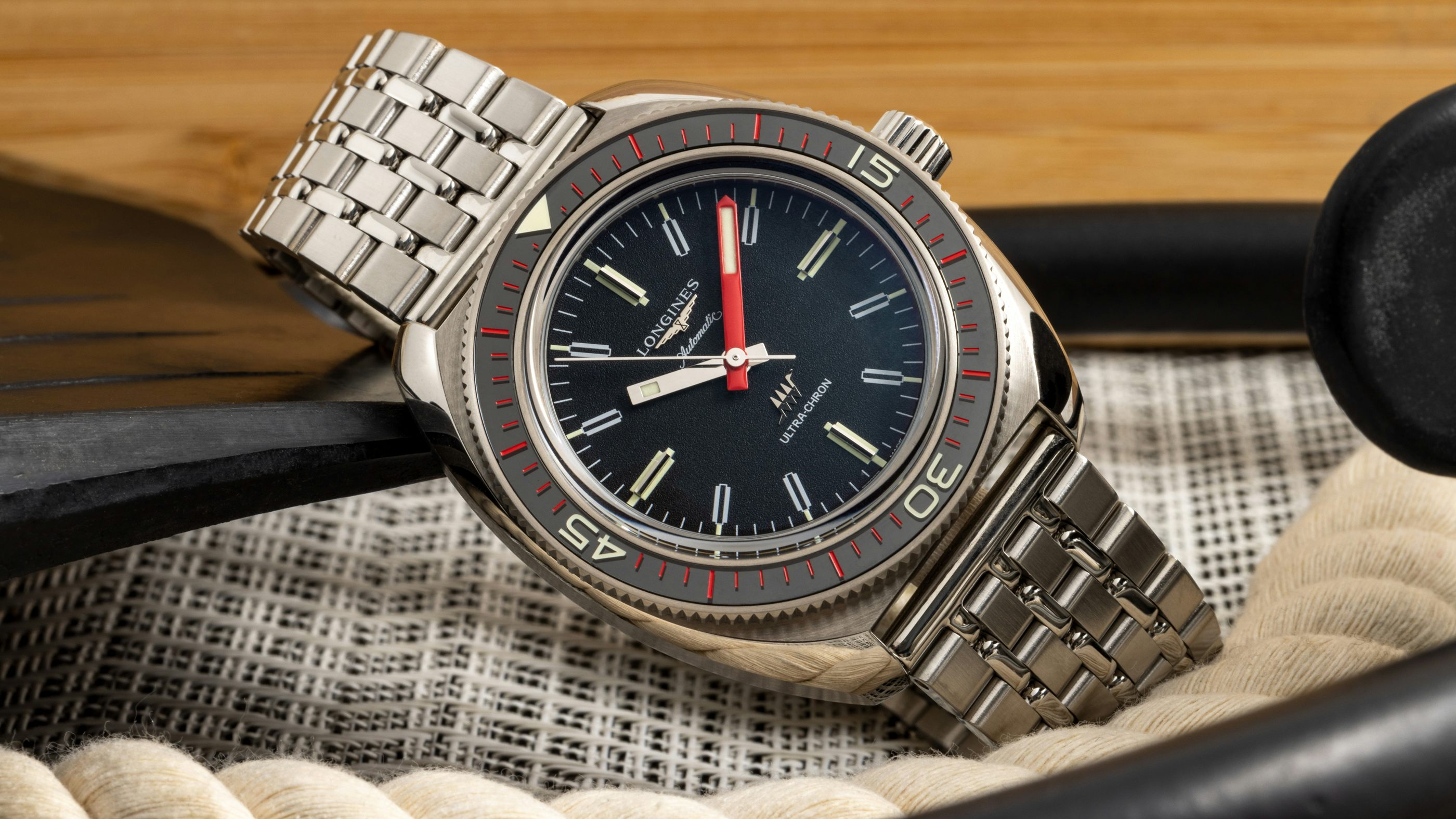 (Above: a modern take on the Original Ref. 7970, but the vintage originals have that unmistakable 1960s character and patina potential. I appreciate how much Longines have follow the original design! Photo credit to hodinkee)
-
2025 Ultra-Chron Classic: Direct homage to the original 1967 dress models in updated 37mm and 40mm sizes.

(Above: Longines's latest reissue of the Ultra Chron, it is close to 1 to 1 a modern take on the Original jumbo. Photo credit to Longines)
These releases have introduced the Ultra-Chron story to an entirely new audience, creating a clear halo effect that benefits the authentic 1960s–1970s originals.
We looking forward to what Longines will bring to the collection next to let watch collectors rediscover the line up!
Frequently Asked Questions About the Vintage Longines Ultra-Chron
The Ultra-Chron Movement & Technical Details
1. What makes the Longines Ultra-Chron movement so special?
The Caliber 431 is a true 36,000 vph (5 Hz) high-beat automatic that delivers an incredibly smooth sweeping seconds hand and was guaranteed to ±1 minute per month. Its innovative dry molybdenum disulfide lubrication solved the main reliability issues of early high-frequency movements, making it both accurate and practical for daily wear.
2. Is the vintage Caliber 431 still serviceable today?
Yes, absolutely. Many experienced independent watchmakers and Longines Heritage service can perform full overhauls. Parts availability is surprisingly good for a movement that is over 50 years old.
The Jumbo Models
3. What is the “Jumbo” Ultra-Chron and why is it the most popular?
The Jumbo refers to the 37mm dress models (mainly Refs. 7951 and 8301 series) with distinctive triangular/faceted lugs. They offer perfect modern sizing, elegant crosshair dials, and the full high-beat experience in a highly wearable package.
4. What should I look for when buying a vintage Longines Ultra-Chron Jumbo?
Focus on original crosshair dials, crisp case-back engravings, sharp triangular lugs (avoid over-polished examples), and recent service history. Steel models (7951/8301) offer the best value and daily wearability.
Pricing & Investment
5. How much does a good vintage Longines Ultra-Chron cost today?
Steel Jumbo models typically range from $900 – $2,800 USD in serviced condition. Gold-capped or solid 18k versions usually fall between $1,800 – $4,500. The early diver (Ref. 7970) sits around $2,200 – $4,000.
6. Will the modern Ultra-Chron reissues affect vintage prices?
They actually help. The 2022 Diver and 2025 Classic reissues have increased awareness of the Ultra-Chron name among new collectors, creating a positive halo effect for the authentic 1960s–1970s vintage pieces.
General Questions
7. Is the Longines Ultra-Chron a good first vintage high-beat watch?
Yes — it’s one of the most underrated and accessible entry points into high-beat collecting. You get genuine 1960s Swiss innovation, excellent accuracy, and beautiful design at a fraction of the price of Zenith or Girard-Perregaux contemporaries.
8. Are gold Ultra-Chron Jumbos worth the premium?
For collectors who love patina and long-term value retention, yes. However, the stainless steel Jumbos offer the best balance of beauty, comfort, and affordability for daily wear.
Have more questions about the Longines Ultra-Chron?
Feel free to reach out to us at The Samurai Vintage. We specialize in carefully inspected and serviced vintage Longines Ultra-Chron pieces with full transparency. We’d be happy to help you find the perfect Jumbo or Diver for your collection.

Written by Will
Co-founder, Samurai Vintage
Thanks for spending time reading my sharing. This is Will, Co-founder of Samurai Vintage. With over 10 years of experience collecting and curating Japanese vintage watches, what started as a personal hobby has grown into one of Asia’s few dedicated JDM-focused vintage watch shops here. I love sharing interesting stories and insights with fellow enthusiasts like you so we can grow our passion for affordable vintage watches together. Cheers and enjoy!
Leave a comment